×
PCC-Grading uses cookies to improve your browsing experience and measure site usage. By clicking on "Accept all", you consent to the use of these cookies.

Cookie settings
Cross
Error

Warning: Undefined array key "mess" in /var/www/html/grade-report/index.php on line 79

Warning: Undefined variable $ in /var/www/html/grade-report/index.php on line 79
What is a Grading Report ?
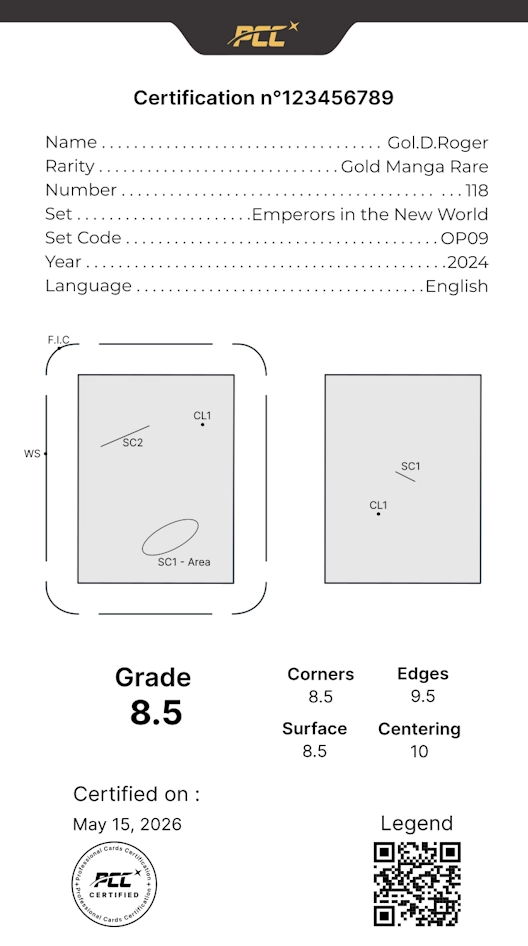
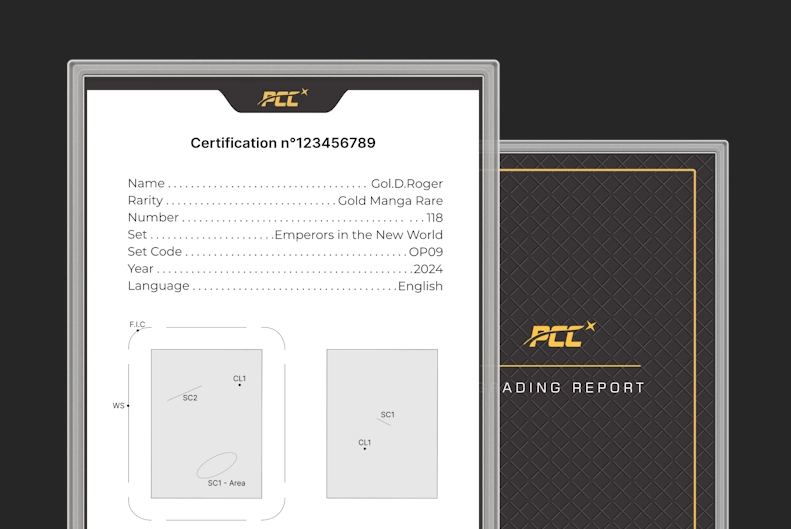
A grading report is a detailed document that accompanies a card after its evaluation by PCC Grading. This report presents the card's edition characteristics and thoroughly details the imperfections encountered during the grading process. In addition to its paper version, the grading report is also available online on the card verification page. Find an example of a verification page. Thus, the grading report is a guarantee of transparency and a mark of trust for collectors and buyers, as it certifies the exact condition of the card according to objective criteria.
PCC grading report: Gol.D.Roger #118 Emperors in the New World – Grade 8.5 (Corners 8.5, Edges 9.5, Surface 8.5, Centering 10)
Certification number
The certification number is a unique identifier assigned to each graded card, allowing verification of its authenticity and access to its grading report via the database. This number ensures traceability, limits counterfeits, and strengthens collector confidence during transactions.
Authentication section
This section groups several elements allowing precise identification of the graded card. Here is a detail of the information generally included :
1. Card name
The official name of the card as it appears in the concerned edition.
Example: Charizard (for a Pokémon card) or Black Lotus (for a Magic: The Gathering card).
2. Edition and Release Year
The expansion or series to which the card belongs, as well as its publication year.
Example: Pokémon – Base Set – 1999 or Magic: The Gathering – Alpha – 1993.
3. Card number
Each card in an edition has a unique number allowing it to be distinguished from others.
Example: 4/102 (Charizard in the Pokémon base set).
4. Language
The printing language of the card, as some editions exist in multiple languages.
Example: French, English, Japanese, German, etc.
Card condition section
This section lists the imperfections detected on the card during its evaluation. It helps understand why it received a certain grade and ensures maximum transparency in the grading process.
The benefits for collectors
Understanding the impact of defects on the final grade
Facilitating sale or purchase with full transparency
Allowing comparison of multiple copies of the same card
Grading section
This section presents the subgrades and the overall grade of the card.
The subgrades allow a more detailed evaluation through the following criteria :
• Centering:
Evaluates the alignment of the illustration and text relative to the card edges
• SURFACE:
Analyzes the condition of the surface (scratches, stains, printing defects).
• CORNERS:
Examines the condition of the corners (cutting imperfections, wear, dents).
• EDGES:
Checks the wear and chipping of the card edges.
The certification number is a unique identifier assigned to each graded card, allowing verification of its authenticity and access to its grading report via the database. This number ensures traceability, limits counterfeits, and strengthens collector confidence during transactions.
This section groups several elements allowing precise identification of the graded card. Here is a detail of the information generally included :
1. Card name
The official name of the card as it appears in the concerned edition.
Example: Charizard (for a Pokémon card) or Black Lotus (for a Magic: The Gathering card).
2. Edition and Release Year
The expansion or series to which the card belongs, as well as its publication year.
Example: Pokémon – Base Set – 1999 or Magic: The Gathering – Alpha – 1993.
3. Card number
Each card in an edition has a unique number allowing it to be distinguished from others.
Example: 4/102 (Charizard in the Pokémon base set).
4. Language
The printing language of the card, as some editions exist in multiple languages.
Example: French, English, Japanese, German, etc.
This section lists the imperfections detected on the card during its evaluation. It helps understand why it received a certain grade and ensures maximum transparency in the grading process.
The benefits for collectors
Understanding the impact of defects on the final grade
Facilitating sale or purchase with full transparency
Allowing comparison of multiple copies of the same card
This section presents the subgrades and the overall grade of the card.
The subgrades allow a more detailed evaluation through the following criteria :
• Centering:
Evaluates the alignment of the illustration and text relative to the card edges
• SURFACE:
Analyzes the condition of the surface (scratches, stains, printing defects).
• CORNERS:
Examines the condition of the corners (cutting imperfections, wear, dents).
• EDGES:
Checks the wear and chipping of the card edges.
Security

The PCC Grading stamp makes counterfeiting complex and allows effective verification of a grading report's authenticity.
Storage
At PCC Grading, the dimensions of the paper grading report have been designed to fit into the notch allowing cases to be stacked on top of each other. This makes it easy to keep the report with its case.
Population Report
In its digital version, the Grading report also comes with a Population report. This indicates the number of copies of a card graded by PCC Grading, according to their grade.
1. Content of the Population Report
The report specifically displays for each card:
1
The total number of graded copies
2
The distribution of assigned grades (e.g., how many received 10, 9, 8, etc.).
3
The variants taken into account: edition, language, possible printing errors.
2. Where to Find the Population Report?
Available on our website, via the certification number or a card search.
Also accessible via the QR Code on the card's label.