

You have control over the cookies used.
 You have control over the cookies used.
PCC-Grading uses cookies to improve your browsing experience and measure site usage. By clicking on "Accept all", you consent to the use of these cookies.

 Go back
 6 minutes of reading
The trading card market (TCG) is experiencing exceptional growth. Unfortunately, this dynamic also attracts ill-intentioned individuals, and card thefts are becoming more frequent. Losing a rare or sentimentally valuable card is a frustrating experience for any collector.
At PCC-Grading, we place security and transparency at the heart of our approach. That is why we are implementing an official stolen card declaration system, aimed at better protecting collectors and complicating the resale of stolen cards.
Each PCC-Grading certified card has a unique identification number, accessible via our online verification tool. Until now, this system mainly allowed verifying a card’s authenticity.
From now on, this tool also becomes a way to fight against stolen card trafficking.
In case of theft, you can report your card at the following address:
stolen@pcc-grading.com
Please include:
• The PCC-Grading certification number
• A description of the theft
• If possible, proof of ownership
After verification, the card will be officially registered as stolen.
As soon as a card is reported stolen, any search of its certification number will immediately display:
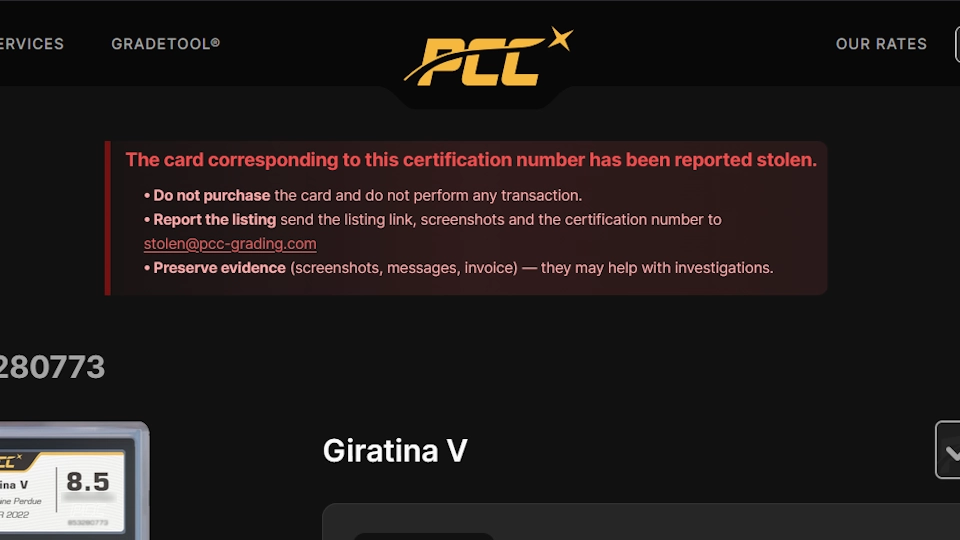
A red alert box indicating that the card is reported stolen.
This message appears for any user performing a check: collectors, buyers, resellers, shops…
One of the great advantages of this system is that it mobilizes the entire TCG community.
• Many collectors check cards before buying them, especially on sales platforms.
• If a stolen card appears in a listing, the future buyer can check its number.
• Seeing the red box, they immediately understand it is a reported stolen card.
• They can then contact us to send the link to the listing or the seller’s information.
• These reports can provide crucial leads and help find the card or identify the person trying to resell it.
In other words, the more collectors use PCC-Grading verification, the harder it becomes for a thief to go unnoticed.
A thief may try to bypass this system by breaking the case to re-certify the card elsewhere. In this case, PCC traceability is lost.
However:
Breaking a case can damage the card, greatly reducing its value.
This forces the thief to pay for a new certification.
A damaged card may receive a lower grade, making it less attractive.
Thus, reporting a stolen card increases the risk for the thief and reduces their chances of resale.
This system only makes sense because it relies on an active, responsible, and passionate community.
Every check, every report, every vigilance can contribute to:
preventing the resale of stolen cards,
protecting the market,
and sometimes even recovering lost cards.
Grading
Company specialized in TCG card grading, we use an advanced tool to evaluate the condition, centering and details of the cards. Guarantee of an accurate and reliable rating to enhance your collections.


