New user? Create an account
Already have an account? Log in

 Go back
 8 minutes of reading
The Pokémon TCG card market is booming, and unfortunately, so is the counterfeit market. As a grading company, we receive every week cards that look perfect to the naked eye... but fail miserably under our tools.
At PCC-Grading, we don’t rely on simple visual inspection. Here are the 4 physical tests our experts systematically apply to detect a fake.
Real Pokémon cards use a very fine screen printing. Fakes print in low resolution.
What we look for:
Real: A regular but extremely fine dot pattern, forming a smooth gradient.
Fake: Coarse dots, smudges, visible pixels, or conversely a grainy inkjet flat.
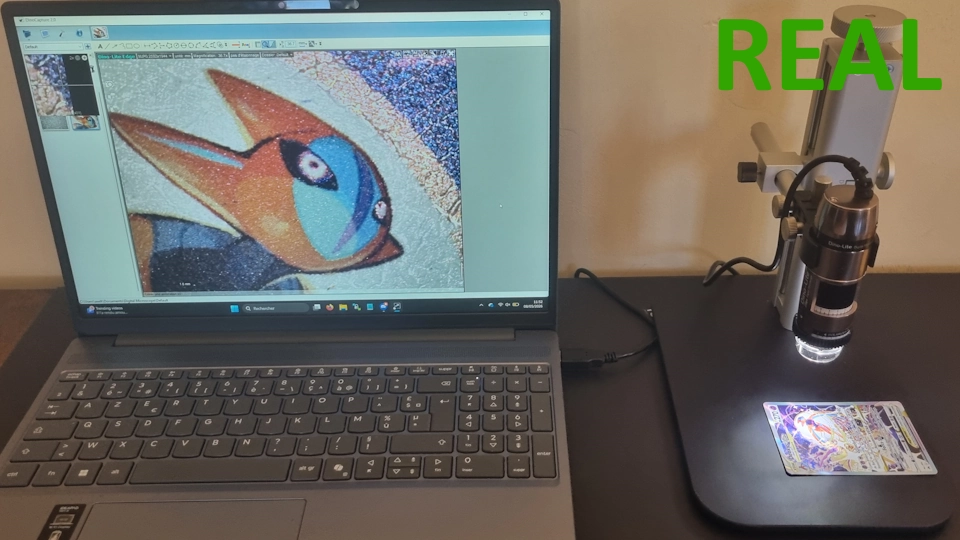
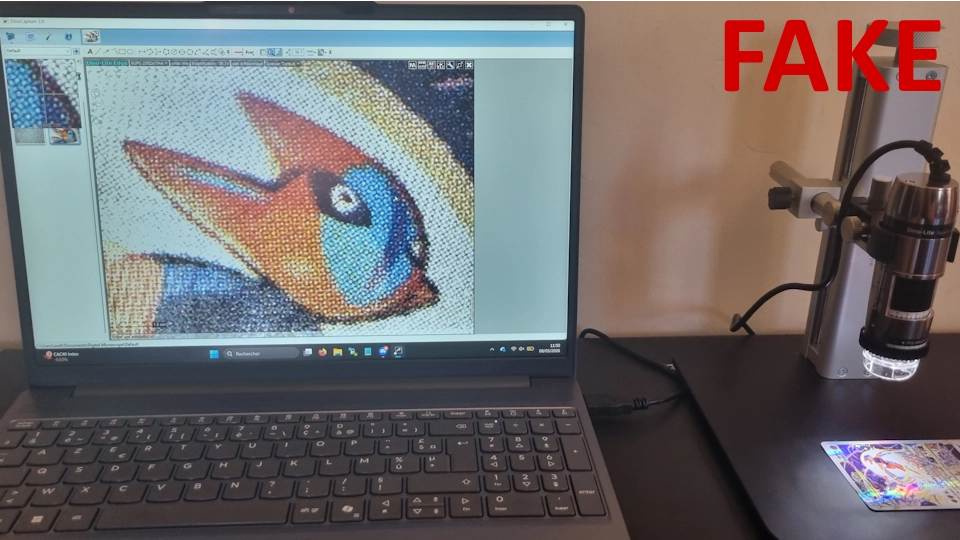
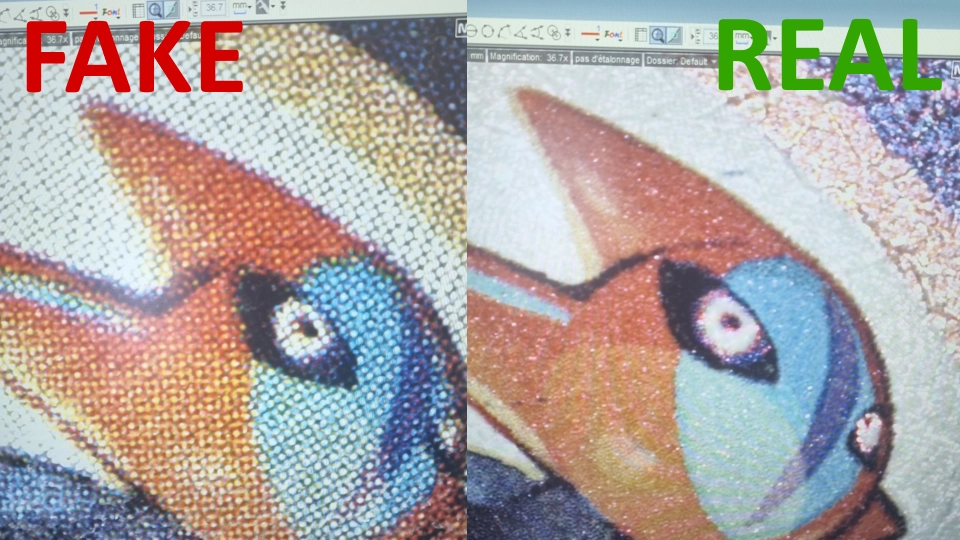
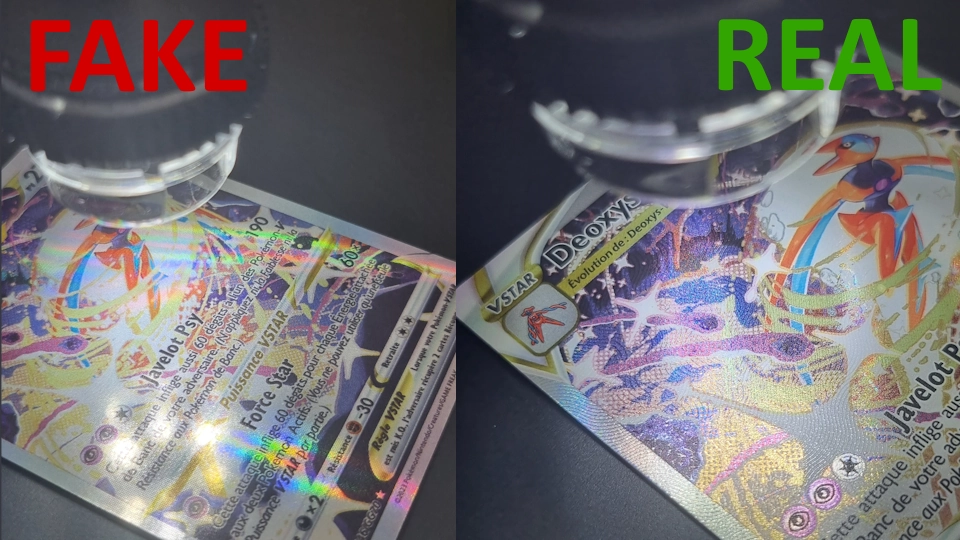
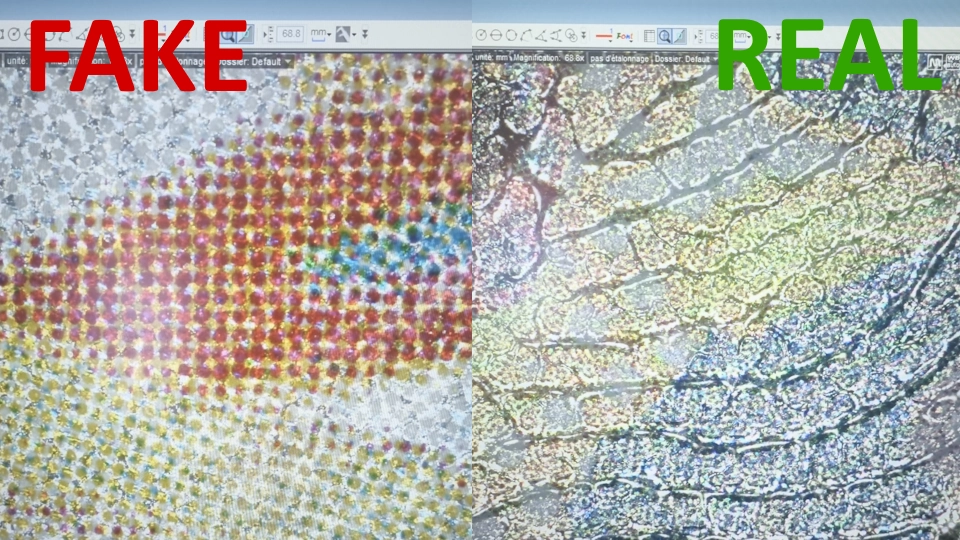
Equipment used by us:
We use the Dino-Lite Edge 5MP AM7515MZT (EAN: 4712805475728), a professional digital microscope found in pharmaceutical labs for quality control of tablets and secure packaging.
Why this technical choice?
Variable magnification from 10x to 220x – perfect to switch from an overview of the card to a zoom on the ink.
5 Mpx sensor (2592x1944) Clinical sharpness, you see every printing dot
This is not just a simple Amazon gadget. It is the tool used by banknote authentication experts, pharmacists to track counterfeit medicines, and us, at home, to unmask fake cards.
The UV lamp is not just a tool to fight counterfeits. We mainly use it to reveal the real condition of a card.
What UV light reveals:
Unlike white light, 365 nm UV makes the fingerprint of the surface stand out. Every handling, every rubbing leaves traces invisible to the naked eye. Under UV, the greasy residues of your fingers appear as phosphorescent marbling.
But above all, UV mercilessly exposes all physical defects:
Micro-scratches (even those believed to be nonexistent)
Small impacts (caused by a fingernail or a sleeve edge)
Rubbing on the edges or the holographic surface
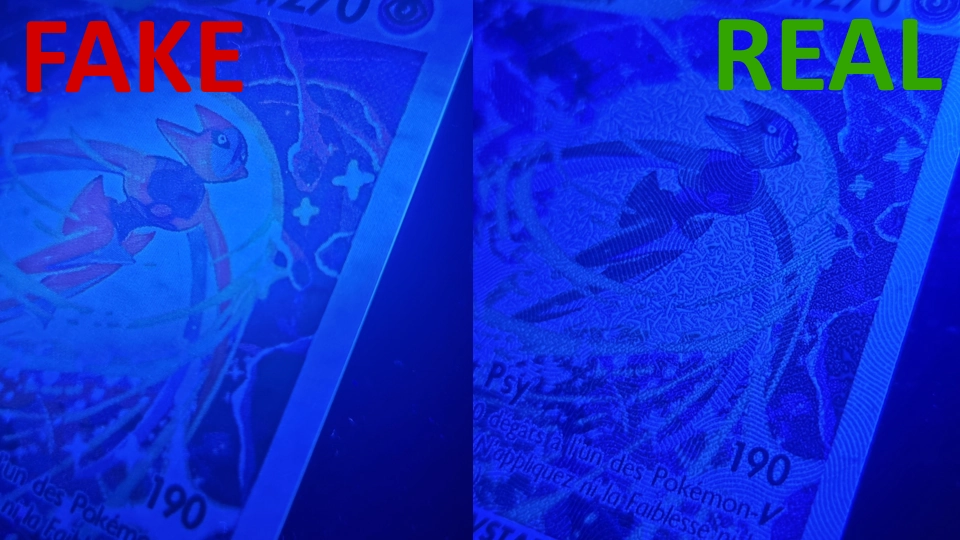
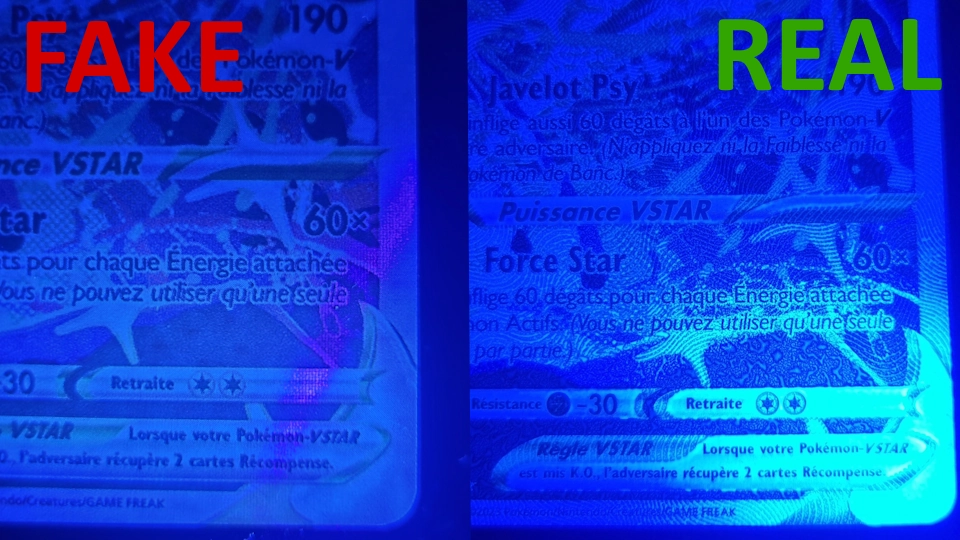
What it looks like:
On an authentic card in good condition: you see a few faint finger marks, few scratches.
On a counterfeit card: either no reaction (bad paper), or abnormal UV patterns. But above all, fakes often show block scratches (printing problem) clearly visible under UV.
This is the least known test, yet the fastest.
How to do it:
Place your card face against a powerful light source (a desk lamp with a cover, or a light pad). Observe the thickness and diffusion of the light.
What you see:

Real: The paper is thick, laminated. No light passes through the card. You just see a very diffuse shadow.
Fake: The card lets a clear light halo through. Sometimes, you can even see the ink on the other side (abnormal transparency). Fakes use less dense paper.
A real Pokémon card weighs between 1.70g and 2.1g depending on the era. A counterfeit card is almost always too light (often 1.35g to 1.60g).
The equipment we use:
We use the precision scale Kern 440-35A (EAN: 4045761068438), a true laboratory classic. It is found both in pharmaceutical labs and in the food and cosmetic industries. It is THE reference for scales
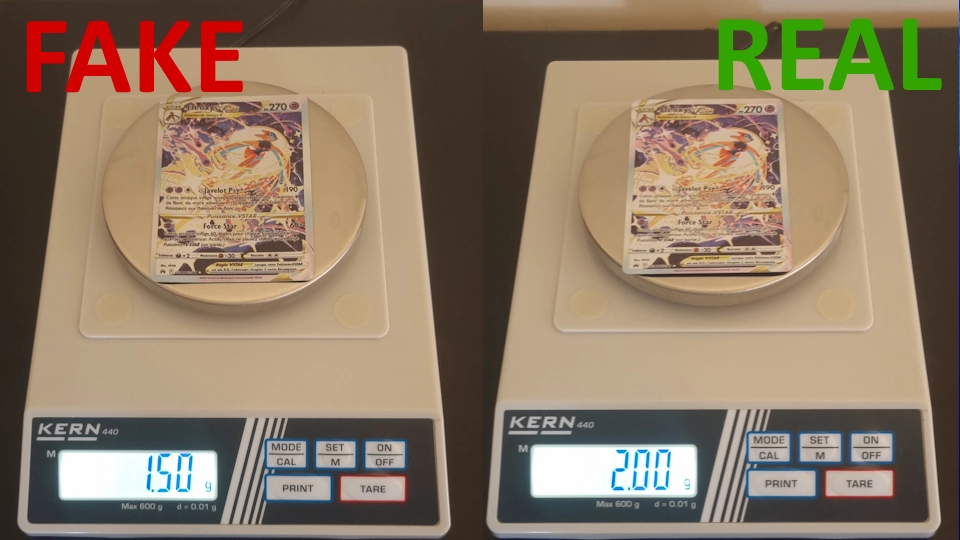
Max capacity: 600 g
Precision: 0.01 g (10 milligrams)
Warning: A card at 1.68g is not necessarily fake, but a card at 1.50g is a red alert. Weight combined with other tests gives certainty.
On recent high-grade cards (Full Art, Secret Rare, Alt Art, Pokémon Company uses a micrometric embossed texture.
Take the card between your fingers, tilt it under grazing light.
Real: You feel ridges, ripples, a unique pattern like a fingerprint. The texture follows the contours of the design (e.g., the sea waves on a Kyogre Alternate Art).
Fake: Either the card is perfectly smooth (glossy varnish), or it has coarse and parallel ridges (very square), often over the entire surface. Counterfeiters cannot reproduce an organic relief.
Conclusion: A counterfeit can pass 1 or 2 of these tests, but never all 4 simultaneously. At PCC-Grading, we leave nothing to chance. Have doubts? Get your cards graded, our team will provide you with an irrefutable authenticity report.
Grading
Company specialized in TCG card grading, we use an advanced tool to evaluate the condition, centering and details of the cards. Guarantee of an accurate and reliable rating to enhance your collections.
 You have control over the cookies used.