

You have control over the cookies used.
 You have control over the cookies used.
PCC-Grading uses cookies to improve your browsing experience and measure site usage. By clicking on "Accept all", you consent to the use of these cookies.

Having a One Piece card certified means entrusting it to a specialized company to verify its authenticity, precisely assess its condition, and protect it in a sealed case. After analysis, the card receives a grade, a certification number, and a grading report detailing its main preservation criteria.
In this guide, discover which One Piece cards to have graded, how to check their condition before shipping, the criteria considered during grading, the price of a certification, and how grading works at PCC-Grading.
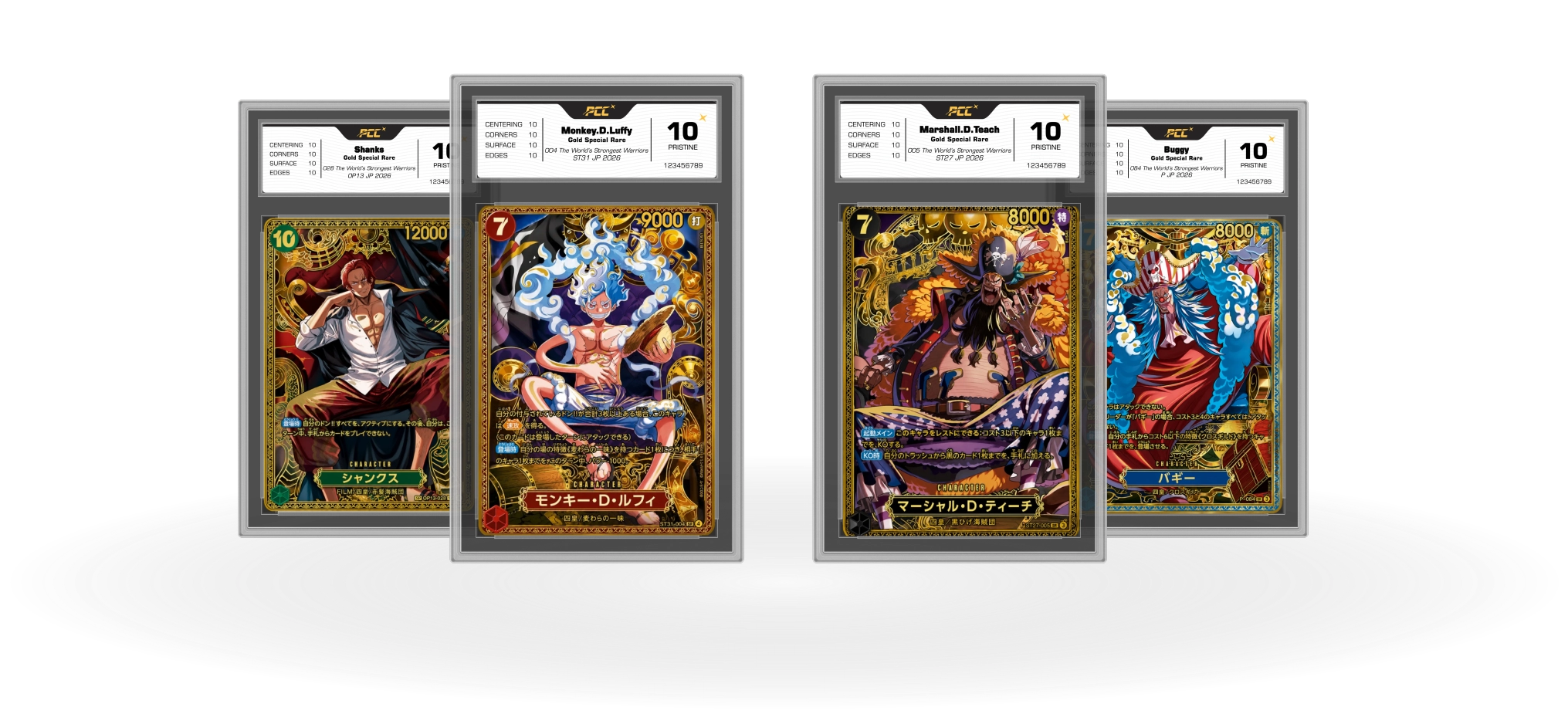

The certification of a One Piece card, also called grading, is a professional process made up of three main operations:
The certified One Piece card receives a unique certification number allowing its information to be found online. It is also accompanied by a detailed grading report and population report data.
In collectors' language, the terms “certification”, “grading”, and “grading” generally describe the same process. Authentication, however, refers to a specific step: confirming that the card is genuine, notably by examining its dimensions, weight, materials, print quality, colors, and textures. Grading then follows to assess its condition according to four subgrades.
A certified One Piece card is placed in a transparent case along with a label. This generally shows the card's name, its set (for example OP-01, OP-02…), its number, its language, its grade, and its certification number. At PCC-Grading, the overall grade is accompanied by four subgrades and a grading report explaining the defects observed.
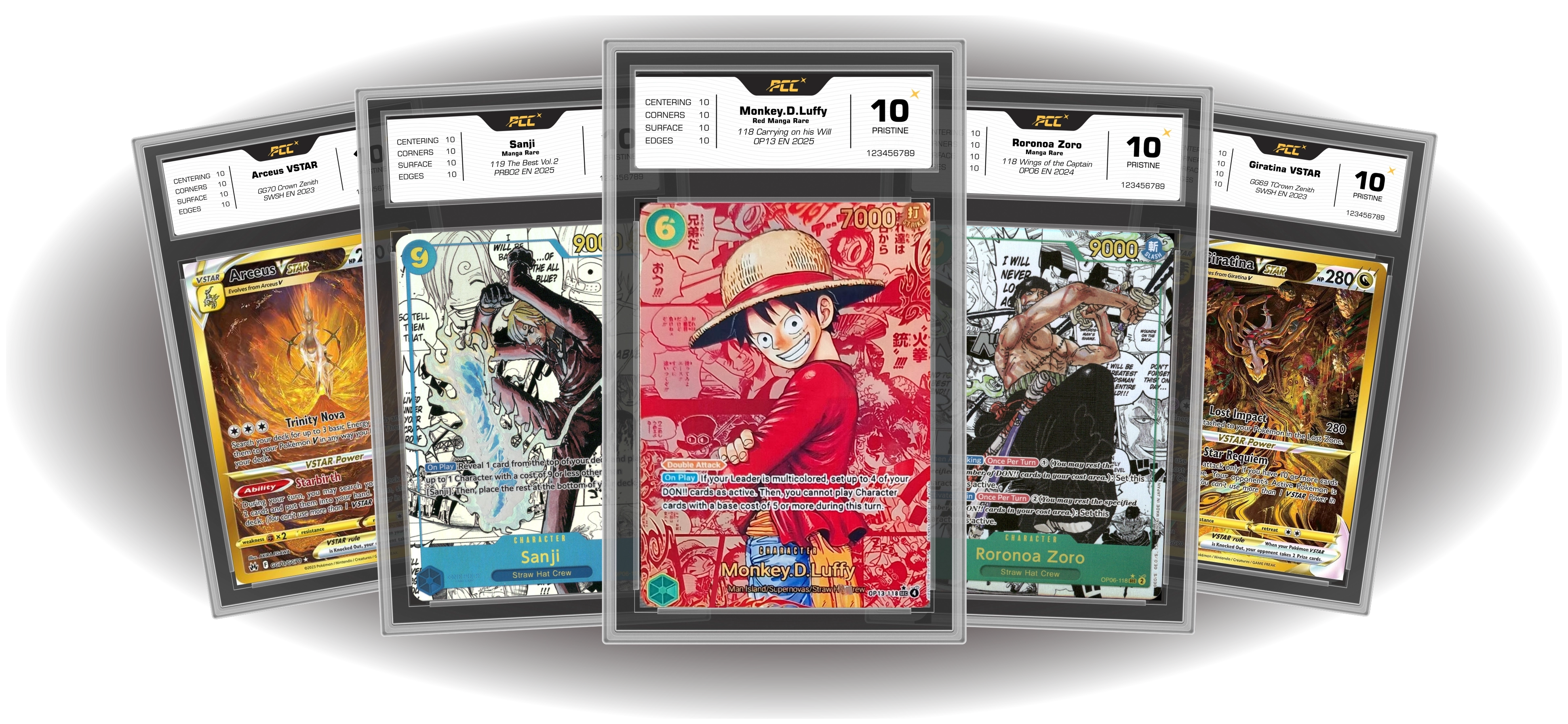
A card can be sensitive to handling, friction, scratches, or impacts on the corners and edges. The glossy or textured surfaces of certain rare cards also make small imperfections particularly visible.
After certification, the card is placed in a sealed rigid case, which limits direct handling and helps preserve its condition over the long term.
The higher a card's value, the more important the question of its authenticity becomes. Certification therefore includes an authentication phase to examine the card's physical and visual characteristics in order to verify their consistency with an official copy.
This step can notably cover dimensions, weight, materials, print quality, colors, textures and surface effects, as well as characteristics visible under different lighting. Once certified, the card receives a unique certification number allowing its information to be found online.
A card that looks perfect at first glance is not necessarily so. A micro-scratch on a foil area, a very slight white spot on the back, a slightly worn corner, a print line, or imperfect centering can affect the final grade.
Grading thus provides a structured assessment of a card's condition based on four criteria called “subgrades”: Surface – Corners – Edges – Centering. At PCC-Grading, each of these criteria receives its own grade.
Condition is one of the main topics discussed when buying a card. A certified One Piece card provides the buyer with more information: reference, language, grade, subgrades, certification number, and detailed report. Grading does not automatically guarantee an increase in value, but a sought-after card that receives an excellent grade may attract greater interest among collectors.
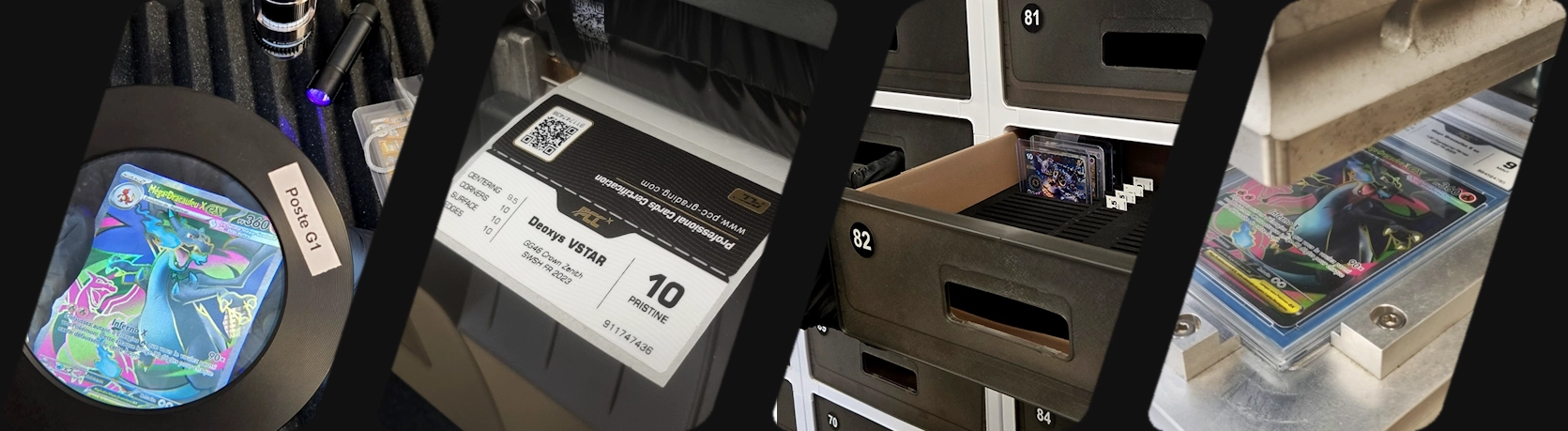
Not all One Piece cards necessarily benefit from being certified. The choice mainly depends on rarity, demand, the condition of the copy, and your collecting goal.
These cards are among the pieces particularly prized by One Piece collectors. Their rarity, their instantly recognizable artwork, and their potential value make them natural candidates for certification. Surface condition is especially important here.
Alternate Arts, often abbreviated “Alt Art” or “AA”, hold a major place in One Piece collections. An Alternate Art in excellent condition can be particularly worthwhile to grade.
Leader cards in alternate versions are also highly prized and often serve as centerpieces of a set. Certification helps protect them while showcasing their artwork in a suitable case.
Promotions, events, Championship, Treasure Cup, or other special distributions can produce cards available in different quantities or conditions than standard cards. Their authentication and condition traceability are then especially valuable.
The earliest sets such as Romance Dawn [OP-01], Paramount War [OP-02], or Pillars of Strength [OP-03] hold a special place in the history of the One Piece Card Game.
Your first big pull, your favorite character, a card obtained at an event, or a gift can very well deserve certification, in order to protect and showcase the card over the long term.
No. The expression “pack fresh” simply means the card has just come out of a booster: it is not an indication of grade. A brand-new card may already show imperfections from manufacturing, packaging, or shipping.
Inspecting the card from several angles is especially important for One Piece cards with glossy, foil, or textured surfaces.
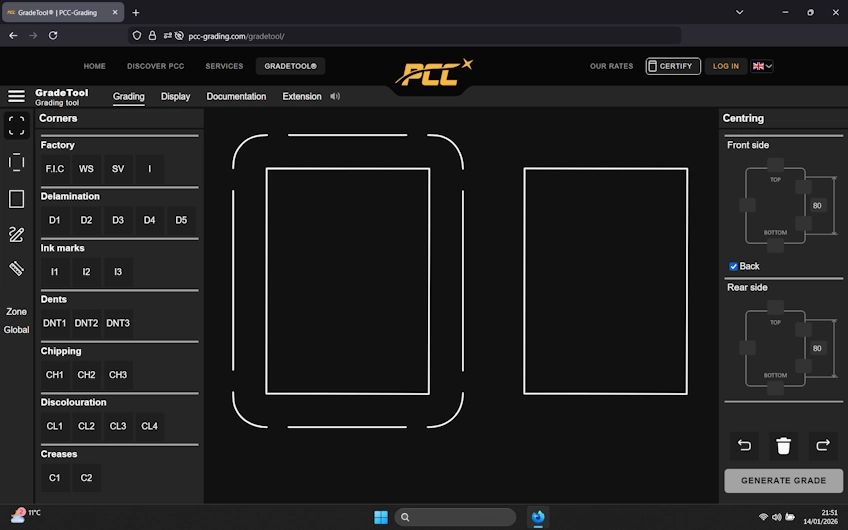
Before sending your card for certification, use GradeTool, PCC-Grading's free pre-grading tool.
It lets you assess your card according to the four criteria of the PCC system:
Examine the front and back under sufficiently strong light, then gradually tilt the card to reveal any micro-scratches, print lines, marks, or dents. Also inspect the corners and back for white spots.
Then enter the observed defects into GradeTool. The tool automatically calculates the four subgrades and provides an estimate of the overall grade, allowing you to compare several copies of the same card before deciding which ones to send for certification.
The pre-grading result remains indicative: only the physical analysis carried out by PCC-Grading can assign the final grade.
Choose the cards you want to protect or showcase. Manga, Alternate Art, Leader, promo, early set, or simply a favorite card: the decision depends on your goal.
Go to our certification center, select One Piece, then enter the information for your card. You can then choose the options and level of service you want.
Place each card in a clean sleeve, then in a suitable semi-rigid protector. Handle the cards carefully to avoid creating new marks just before certification.
Avoid any shifting or impact during transport by following the best practices in our shipping guide, which details the steps to protect and ship your cards safely to our facility.
After receipt at PCC-Grading, your order goes through the 6 successive steps of the process. Its progress can be tracked from your customer account.
Once authentication, grading, printing, and sealing are complete, the cards go through a final check before shipping. Each card is linked to its unique certification number and grading report.
At PCC-Grading, the card is first checked, then examined with suitable tools to identify any defects present. Each defect detected is logged in GradeTool, the grading tool developed by PCC-Grading. The algorithm then calculates the four subgrades and the final grade according to the rules of the grading system.
The analysis may cover dimensions, weight, materials, print quality, colors, and the card's reaction under intense light. Some criteria are specific to One Piece cards, notably the appearance of Manga Rare, Alternate Arts, and foil effects.
| Subgrade | Elements observed | Examples of defects |
|---|---|---|
| Surface | Front and back | Scratches, print lines, stains, creases, dents, residue |
| Corners | The four corners | White spots, crushing, peeling, cutting defects |
| Edges | The four edges | Abrasion, color loss, chipping, irregularities |
| Centering | Print position and rotation | Horizontal or vertical shift, rotation |
A card with a very damaged surface cannot be considered perfect simply because its corners and centering are excellent. At PCC-Grading, the overall grade therefore takes into account the lowest subgrade according to the rules of our grading scale, in order to remain representative of the card's actual condition.
A grade alone shows a result, it doesn't explain why the card received it. That's why every PCC-Grading certification includes a physical and digital grading report.
This report may notably include:
The report therefore accompanies the card beyond its first owner. During a sale or trade, a future collector can also consult the information associated with the certification.
This price includes:
| Option | Current price | Description |
|---|---|---|
| Post-Grade Photography | 3 € / card | UHD front and back photos of the encapsulated card |
| Security Pack | 4 % of declared value | Enhanced protection including insurance and vault storage |
| CrossGrade | 2 € / card | Secure opening of the case of an already certified card |
PCC-Grading offers three levels of service. Turnaround times begin upon receipt of the cards at our facility and do not include outbound and return postal shipping.
| Service level | Processing time | Surcharge |
|---|---|---|
| Normal | 30 business days | Included |
| Express | 10 business days | + €5 / card |
| Super-Express | 2 business days | + €20 / card |
Order progress can be tracked from the customer account.
A grading company must be able to build enough trust for the grade obtained to retain real meaning over the long term. Before sending an important One Piece card, be sure to check:
PCC-Grading developed its service with one goal: to offer premium grading in which the grade can be understood, verified, and reproduced according to a defined method.
Every card receives four subgrades and a report detailing the defects observed. Collectors therefore don't just receive a grade: they have the information needed to understand where it comes from.
Experts detect and log imperfections in GradeTool, while the grade calculation is carried out according to the rules defined by the PCC system. This approach limits subjective variation between two gradings.
PCC-Grading is growing its service across Europe with a site available in several languages and a positioning aimed at both collectors and TCG professionals.
A Manga Rare or a beautiful Alternate Art deserves to be showcased. The PCC-Grading case, label, and report have been designed as a cohesive, understated, premium whole so as to protect the card without overshadowing its artwork.
Manga Rare, Alternate Art, Leader, promo, or favorite card: protect your finest One Piece cards in a premium case and get a four-subgrade grading along with a detailed report.
PCC-Grading certification: 20 € per card.
In the trading card world, the terms “certifying”, “grading”, “having graded”, and “grading” generally describe the same process: authenticating the card, assessing its condition, assigning it a grade, and encapsulating it in a sealed case.
PCC-Grading certification costs 20 € per card. It includes authentication, four subgrades, the grading report, the case, the certification number, and inclusion in the population report.
Manga Rares, Alternate Arts, alternate Leaders, promotional cards, tournament cards, and particularly sought-after cards are often good candidates. A card can also be certified purely for its sentimental or aesthetic value.
Yes. Japanese One Piece cards can be submitted to PCC-Grading; the card's title will then be translated into English on the label and grading report.
It's not mandatory, but a Manga Rare is generally a particularly good candidate due to its rarity and appeal to collectors. Certification notably helps protect the card, authenticate the copy, and precisely determine its condition.
No. A brand-new card may already show poor centering, a micro-scratch, a white spot, a print line, or an imperfection on a corner or edge from manufacturing.
You can use GradeTool for free to get a pre-grading based on the four PCC criteria: Surface, Corners, Edges, and Centering. The result gives you an initial estimate before shipping, but only a physical examination determines the final grade.
PCC-Grading's Normal service is completed within 30 business days of receiving the cards. The Express and Super-Express services allow for processing within 10 and 2 business days, respectively.
It can boost the value of certain sought-after cards, especially when they receive an excellent grade, but no increase is guaranteed. The final value depends on the card, its rarity, demand, and the grade obtained.
Every card receives a unique certification number giving access to its verification page. This lets you view its identity, grade, four subgrades, and the information associated with its grading report.
Example verification pageIt depends on your goal. A card meant to be played can stay in a sleeve, while a rare card, a collector's piece, a Manga, an Alternate Art, or a card with strong sentimental value can benefit more from the authentication and protection provided by certification.
Grading
Company specialized in TCG card grading, we use an advanced tool to evaluate the condition, centering and details of the cards. Guarantee of an accurate and reliable rating to enhance your collections.


