

You have control over the cookies used.
 You have control over the cookies used.
PCC-Grading uses cookies to improve your browsing experience and measure site usage. By clicking on "Accept all", you consent to the use of these cookies.

Getting a Pokémon card graded means entrusting it to a specialized company to verify its authenticity, precisely evaluate its condition, and protect it in a sealed case. After the analysis, the card receives a grade, a certification number, and a grading report detailing its main preservation criteria.
In this guide, discover how to get your Pokémon cards graded, which cards to choose, how to assess their condition before shipping, how much grading costs, and how the certification process works at PCC-Grading.

Certification of a Pokémon card, also known as grading, is a professional process made up of three main operations:
The certified card receives a unique number allowing its information to be retrieved. It also comes with a detailed report, a QR code, and a population report showing how many similar copies have received each grade.
In collectors' language, the terms “certification”, “grading” and “authentication” are often used interchangeably. Authentication, however, refers to a specific step: confirming that the card is genuine. Grading then follows to assess its condition. A card can therefore be recognized as authentic without necessarily receiving a condition grade, particularly when it is heavily worn or when its owner requests authentication only.
A certified Pokémon card is placed in a transparent case along with a label. This label generally shows the card's name, set, number within the series, language, grade, and certification number. At PCC-Grading, the overall grade comes with four subgrades and a grading report explaining the defects observed.
Pokémon cards are sensitive to handling, friction, scratches, creases, dust and humidity. Even when stored in a sleeve or binder, they can deteriorate over time.
Encapsulation limits direct contact and preserves the card in a rigid case. The PCC-Grading case is designed to offer long-lasting protection, optimal transparency, and a premium presentation.
Some counterfeits are obvious, but others accurately reproduce the colors, the artwork or the texture of an official card. Authentic cards can also have been retouched, recolored, or altered.
A professional certification adds a verification step covering in particular dimensions, weight, printing, materials, colors, textures, and how the card behaves under different lighting.
Two cards that look identical to the naked eye can receive different grades. A micro-scratch, a white spot, a cutting defect, a print line, a slight indentation, or an off-center print can influence the evaluation.
Certification replaces vague descriptions such as “very good condition” or “near mint” with a grade derived from a defined method. Subgrades and the detailed report make it possible to understand the card's strengths and weaknesses.
A certified card is easier to present to a buyer: its identity, condition, and certification number can be verified. Grading thus reduces some of the uncertainty involved in buying an ungraded card.
Not all cards are certified for financial reasons. A collector may want to protect a card from childhood, an illustration they love, a card obtained at an event, or a centerpiece of their collection. The case then provides a consistent presentation and allows the card to be displayed without being handled.

The best choice depends on your goal. Before sending a card, consider its rarity, condition, potential value, the total cost of certification, and its importance within your collection.
Vintage, promotional, secret rare, Illustration Rare, Special Illustration Rare, alternate art cards, tournament cards, or limited distributions can be of particular interest. A sought-after card benefits more from protection and a clear statement of its condition.
A modern card of moderate value can become worth certifying when it is in exceptional condition. However, you should avoid assuming that a card fresh out of a booster pack is flawless: printing, cutting, and centering defects can be present right from manufacturing.
For a vintage, rare card, a lower grade does not necessarily make certification less worthwhile. Authentication, protection, and traceability can matter more than chasing a perfect grade.
A card kept since childhood or tied to a memory can deserve certification regardless of its market value. In this case, protection and presentation become the main deciding factors.
A certified card reassures buyers more, since its authenticity and condition have been evaluated by a specialized company. The grade, subgrades, and certification number reduce the uncertainty tied to photos or sometimes subjective seller descriptions.
Profitability, however, depends on the card's rarity, its current value, its condition, and the grade obtained. It is therefore recommended to compare sale prices for the ungraded card against certified copies with a similar grade.
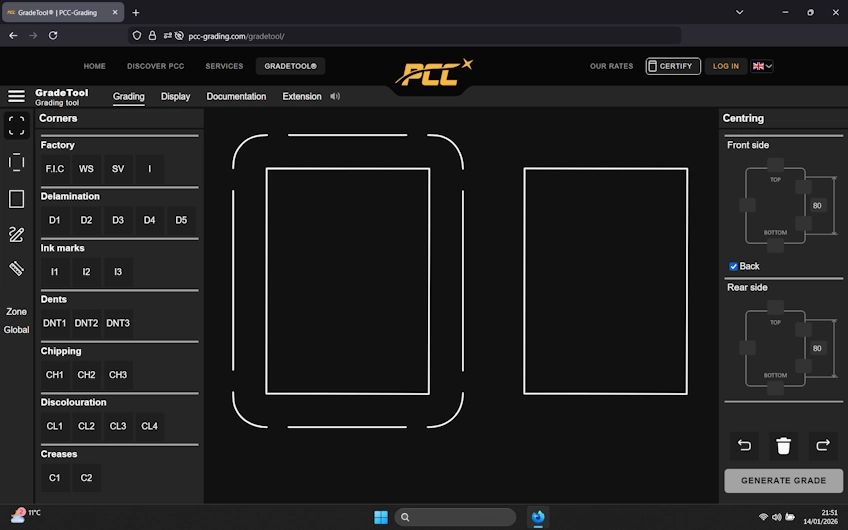
Before sending your card for certification, use GradeTool, PCC-Grading's free pre-grading tool.
It lets you assess your card according to the four criteria of the PCC system:
Examine the front and back from several angles, ideally under raking light, to spot scratches, white spots, indentations, signs of wear, or centering defects.
Then enter the defects observed, their location, and their severity into GradeTool. The tool automatically calculates the four subgrades and provides an estimate of the overall grade.
This estimate helps you compare several cards and select the ones that seem most worth certifying.
The result remains indicative: the final grade is assigned only after physical examination of the card by PCC-Grading
Choose the cards that matter to your collection, your resale project, or their sentimental value. Check their overall condition and estimate their declared value based on comparable sales.
Go to the PCC-Grading certification center, select Pokémon, and enter each card's details: name, set, number, language, and declared value. Then choose your options and processing level.
Place each card in a clean sleeve, then in a suitable semi-rigid protector. Avoid protectors that are too tight, and never stick adhesive tape directly onto the sleeve or the card.
Keep the order shown on the summary, keep the stack of cards secured in the center of the package, and include the requested documents. Use packaging rigid enough to withstand shipping.
Once received, the package's compliance is checked. You can track your order's progress from your customer account, from receipt through to shipping.
After authentication, grading, printing, sealing, and quality control, your cards are protected for their return. Each card is linked to its certification number and grading report.
At PCC-Grading, the card is first checked, then examined with suitable tools to identify any defects present. Each imperfection detected is entered into GradeTool, the grading tool developed by PCC-Grading. The algorithm then calculates the four subgrades and the final grade according to the grading system's rules.
The analysis may cover weight, dimensions, print characteristics, colors, texture, materials, and how the card reacts under intense or ultraviolet light. Some criteria are specific to Pokémon cards, particularly the appearance of the back and the consistency of its colors.
| Subgrade | What is examined | Examples of defects |
|---|---|---|
| Surface | Front and back of the card | Scratches, stains, creases, indentations, deposits, print lines. |
| Corners | Individual condition of the four corners | White spots, crushing, peeling, cutting defects. |
| Edges | Condition of the four edges | Chipping, abrasion, color loss, irregularities. |
| Centering | Position and rotation of the print | Unbalanced borders, shifting, or rotation. |
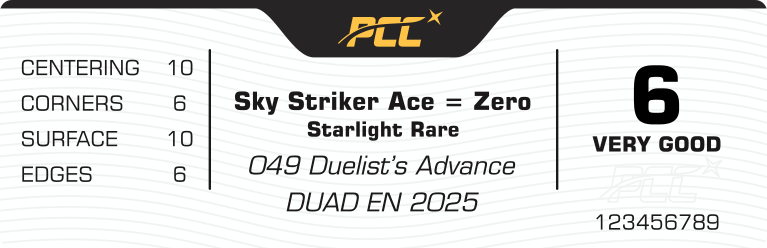
A card's overall condition cannot be accurately summarized by an arithmetic average. A heavily scratched surface does not disappear because the centering is excellent. As a result, the overall grade corresponds to the lowest of the 4 subgrades, for example:
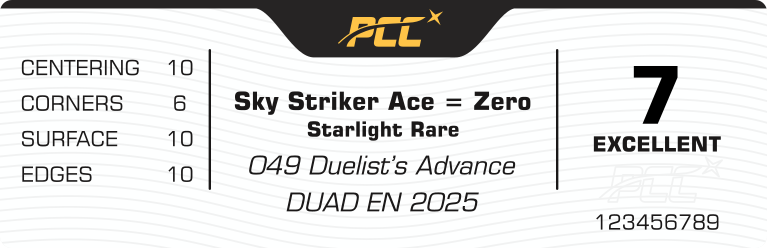
Special case: when the lowest grade appears in only one subgrade, the final grade is raised by one level on the grading scale.
Factory defects and wear defects
PCC-Grading distinguishes imperfections resulting from manufacturing (poor centering, print lines, imperfect cutting, etc.) from alterations caused by handling and storage. This distinction helps to better explain the card's actual condition and the resulting grade. Discover the list of defects that can be found on a Pokémon card.
A grade alone doesn't always explain the result. PCC-Grading therefore includes a grading report with every certification. This report is available in physical format and in digital format on the card's verification page.
The report may include:
This transparency helps you understand the grade and gives a potential buyer more information about the copy being offered.
This price includes:
| Option | Current price | Purpose |
|---|---|---|
| Post-Grade Photography | €3 / card | UHD front and back photos of the encapsulated card, useful for an online sale listing |
| Security Pack | 4% of the declared value | Insurance in-house and during return shipping, with storage in a vault |
| CrossGrade | €2 / card | Secure opening of a case for a card already certified by another company. |
PCC-Grading offers three processing levels. Turnaround times begin once the cards are received at our facilities and do not include outbound and return postal shipping.
| Plan | Processing time | Surcharge |
|---|---|---|
| Standard | 30 business days | Included |
| Express | 10 business days | + €5 / card |
| Super Express | 2 business days | + €20 / card |
Order progress can be tracked from your customer account. A request for information needed to process the order may temporarily pause the turnaround time until the customer responds.
Price shouldn't be the only criterion. The value of a certification mainly rests on the trust collectors can place in the method, traceability, and quality of service.
PCC-Grading has built its service around precision, transparency, and a clear understanding of the grade. Collectors don't just receive a card in a case: they get the information needed to identify the copy and explain its evaluation.
Every card benefits from four subgrades and a report detailing the defects observed. This lets collectors clearly understand the grade assigned.
Thanks to GradeTool, our experts observe, detect, and record defects without intervening in the grade calculation. This method limits subjective variation and maintains consistent grading over time.
PCC-Grading's website is available in 6 languages and maintains a premium positioning aimed at earning the lasting trust of European collectors and professionals.
The case, label, and grading report were designed as a sleek, elegant whole, protecting the card while showcasing its artwork and rarity.
Authentication, grading with four subgrades, a detailed report, and a premium case: trust your cards to PCC-Grading and follow every step from your customer account.
Certification: €20 per card, with Standard processing included.
In the trading card world, “certifying”, “grading”, and “having it graded” generally refer to the same service: the card is authenticated, its condition is evaluated, a grade is assigned to it, and it is encapsulated in a sealed case.
PCC-Grading certification costs €20 per card. This single price includes authentication, the four subgrades, the grading report, the case, the certification number, and inclusion in the population report. Insurance and expedited processing options are billed separately.
Standard processing is quoted at 30 business days after the cards are received. Express and Super Express processing take 10 and 2 business days respectively. Outbound and return shipping times must be added.
No. A brand-new card can have poor centering, a print line, a white spot, a factory scratch, a cutting defect, or another imperfection. Having just opened the booster does not guarantee a perfect grade.
Yes. PCC-Grading accepts Pokémon cards regardless of their print language, provided they match a supported format. French, English, Japanese, German, Spanish, and other language cards can be submitted.
Yes. A worn card can be authenticated and evaluated. For a heavily damaged card, we recommend opting for simple authentication without a grade. The label will then show A - Authentic instead of a grade.
No. Certification provides authentication, evaluation, and protection, but it does not guarantee a price increase. Value depends on the card, its rarity, demand, the grade obtained, and the trust placed in the grading company.
Place the card in a clean sleeve, then in a suitable semi-rigid protector. Keep the order shown on the summary, keep the cards secured within the package, and avoid any adhesive tape coming into direct contact with the card's immediate protection.
Each card receives a unique certification number. It gives access to its verification page, identification details, grade, subgrades, and grading report.
Example verification pageThe population report shows how many copies of a given reference have been certified and how the grades are distributed. It helps place a card among the other copies recorded by the grading company.
Yes. Both vintage and modern cards can be submitted, regardless of language, provided they meet the service's format and acceptance conditions.
Grading
Company specialized in TCG card grading, we use an advanced tool to evaluate the condition, centering and details of the cards. Guarantee of an accurate and reliable rating to enhance your collections.


